How Do You Know a Cat Is Feral
Stray cats and feral cats are unlike from each other in a very important manner — in their relationship to and interactions with people.
- WHAT IS A FERAL Cat?
- WHAT'S THE Difference Betwixt A STRAY Cat AND A FERAL CAT?
- HOW Practice I TELL THE Difference WHEN THE CATS ARE OUTDOORS?
- HOW Exercise I TELL FERAL AND STRAY CATS APART ONCE I TRAPPED THEM?
WHAT IS A FERAL Cat?
A feral true cat is a true cat who has either never had any contact with people or her contact with people has macerated over time. She is non socialized to people and survives on her ain outdoors. Most feral cats are not likely to e'er become lap cats or enjoy living indoors. Feral cats have had petty or no contact with people, and then they are wary of united states, and cannot be adopted. Feral cats take kittens that tin can exist socialized at an early age and adopted into homes.
A feral true cat's level of socialization and behavior is non always black and white, peculiarly for feral cats that recognize their caregiver. They may show signs of familiarity, such as a tail up or hanging out on a caregiver's porch, but these behaviors are normally limited to the true cat's interaction with the caregiver and only develop later on edifice a relationship over time. E'er remember: this does not mean that the cat is a good candidate for living indoors.
Feral cats have a home—outdoors. They live and thrive in every landscape, from the inner metropolis to rural farmland. Since feral cats are not adoptable, they should not be brought to animal pounds and shelters, because there they will likely be killed.
WHAT'Due south THE Deviation BETWEEN A STRAY Cat AND A FERAL Cat?
A stray cat is a true cat who has been socialized to people at some point in her life, just has left or lost her indoor dwelling, besides as near human contact and dependence. She can go feral as her contact with humans dwindles. A stray true cat can nether the right circumstances become a pet cat over again. Stray cats that are re-introduced to a home later living outdoors may require a menstruation of time to re-acclimatize; they may exist frightened and wary after spending time outside abroad from people.
HOW DO I TELL THE Divergence WHEN THE CATS ARE OUTDOORS?
Since it is difficult to determine each cat'due south socialization during a stressful event such as trapping, it's a practiced thought to detect cats on their ain outdoors using the guidelines below. Remember that these guidelines are not hard and fast rules and that just one of these traits is probably not enough to draw a decision.
Lesser Line : If a true cat you don't know approaches you or if you tin can bear upon her, she is most likely non feral. Not all stray cats will do this though, specially at first—each true cat will act differently in a variety of situations. More monitoring using these guidelines may be necessary to determine if the cat is socialized.
| Devious | FERAL |
| SOCIALIZATION TO HUMANS | |
| May arroyo people, houses, porches, or cars | Will not approach and will probable seek hiding places to avoid people |
| SOCIALIZATION TO OTHER CATS | |
| Will likely live solitary, not be part of a group | May belong to a colony |
| BODY Language | |
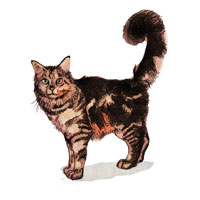
| Might walk and motility similar a housecat, such every bit walking with tail up—a sign of friendliness | May crawl, hunker, stay low to the footing, and protect trunk with tail |
| Volition probably wait at you, blink, or make eye contact | Unlikely to make eye contact |
| Vocalism | |
| May be vocal, meow, or "answer" your voice | Won't meow, beg, or purr |
| SCHEDULE | |
| Will be visible primarily during the daytime | More likely to be nocturnal; occasionally out during the day |
| Physical APPEARANCE | |
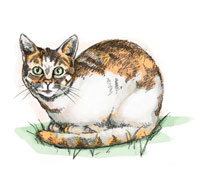
| Volition probably exist dirty or disheveled | Will probably have a clean, well-kept coat.A male with a large head and thick neck, muscular body, and/or scars from fighting is more probable to be feral, since these are traits associated with intact males. He may also take a spiky coat from high testosterone levels and less time spent grooming; may likewise accept "stud tail"—pilus loss, greasiness, or bumps at the base of operations of the tail due to hormones. |
| Will non have an ear tip | Will probable have an eartip if neutered equally part of a TNR plan |
| PREGNANCY, NURSING, KITTENS | |
| A female who is pregnant or lactating is more likely to be feral, since just two% of feral cats are neutered in the U.S. | |
HOW Do I TELL FERAL AND Stray CATS APART ONCE I Take TRAPPED THEM?
When in a frightening or stressful environment—such every bit a trap or a shelter—a friendly stray cat may human activity like a feral cat, avoiding people and possibly fifty-fifty showing aggression to avoid being touched. A lot of cats seem feral in traps but are just afraid.
Hither are some ways that will assist distinguish a feral cat from a scared stray cat when they are frightened, confined, or in a new place.
| Devious | FERAL |
| Affect Bulwark | |
| It may be possible to affect the cat somewhen or she may tolerate a small-scale amount of touching with an object | Cannot be touched, even by a caregiver |
| Muzzle BEHAVIOR | |
May come to the front of the cage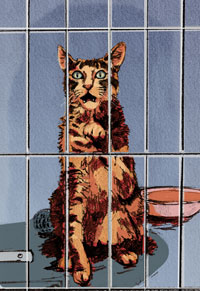 | Will likely stay in the back of the muzzle and retreat as far back as possible |
| May somewhen rub against the cage in a friendly style | If jolted or frightened, may milkshake, rattle, or climb the cage, and could become injured banging into the muzzle |
| LEVEL OF RELAXATION | |
| May relax over time | Will remain tense and unsocial |
| RESPONSIVENESS | |
| May investigate toys or food placed nigh the cage | Will likely ignore all people and toys, and possibly fifty-fifty nutrient |
| May respond to household sounds like cat food cans or bags beingness opened | Will not show any familiarity or interest in household sounds |
| Fright AND ANXIETY | |
May hiss or growl to show anxiety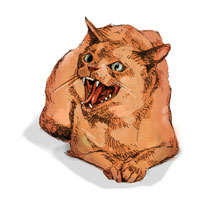 | Will exist aggressive and lash out if threatened or cornered (signs of aggression include ears back and eyes dilated)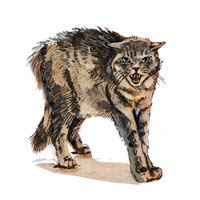 |
Source: https://feralcatfocus.org/feral-or-stray/
0 Response to "How Do You Know a Cat Is Feral"
Post a Comment