Think Harvey like Flooding Couldn t Happen to Sacramento Think Again @ Sacramento Bee
The enormous human tragedy unfolding in Texas, every bit a result of Hurricane Harvey, is a reminder that communities all over the United Country are vulnerable to catastrophe when extreme conditions events hitting. As the nation rallies to help the people of Houston and the Gulf Declension recover, nosotros should also prepare in our own homes and communities to brand sure that we are ready for the next large storm.
Hurricanes and farthermost floods are natural phenomena, but they can become human tragedies and economical disasters when we fail to prepare. Fortunately, we have new experience demonstrating how innovative flood management can gives us more tools to meet this challenge.
In California, American Rivers has been working with the country of California to develop a new flood plan for the Central Valley. In August, the Primal Valley Inundation Protection Board adopted thatnew programme, which will help protect more than than a meg people from devastating floods. Additionally, beyond providing for critical public safe, it will help restore the region'southward rivers, fish and wild animals and groundwater supplies. Past creating new parks and trails, it will also enrich the lives of Californians. More than on that programme, below.
Major floods are becoming more common
The first footstep in preparing for extreme floods is confronting the risk. That risk is easy to overlook. After all, the odds of an extreme storm might be less than 1 per centum in a unmarried year. Your community could go many decades without seeing i. But, eventually, every bit in the instance of the Gulf Coast today, an farthermost storm will arrive. In add-on, climate change isincreasing the flood hazard communities face. Confronting floods is one of the keys to making certain that our communities and natural resource will be resilient equally our climate warms.
California and the Gulf Coast are both uniquely vulnerable to extreme precipitation events. Although the 50 inches Harvey dumped this week is setting a national tape for totals over a single calendar week, California has even more frequent high precipitation totals over three day periods. The following map from a scientificarticle nearly atmospheric rivers in the periodical "Water" shows how California and the Gulf Declension both stand out when it comes to extreme precipitation.
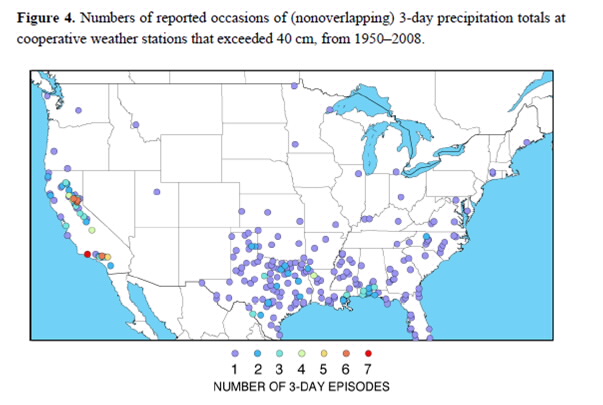
Atmospheric rivers are jets containing staggering quantities of moisture from the torrid zone that periodically deluge California and account for about of our floods and h2o supply. The slap-up flood of 1862, which destroyed 1/3 of the taxable property in California, was almost certainly caused by an atmospheric river. A few years agone, the USGS attempted tosimulate what might happen if we were struck with a similar ARk storm (Atmospheric River 1,000 yr outcome) today and concluded that the resulting flood would displace 1.5 million people and cause flood damages totaling a whopping $725 billion.
If you are thinking that a 1,000 year issue is besides improbable to worry about, recollect again. There is testify of 6 storms in the geologic tape over the last 1,800 years that are larger then the flood of 1862. Nosotros are overdue. In addition, climate change could increases the hazard we face, ifmore of the precipitation falls as pelting rather than snow at the higher elevations of the Sierra Nevada.
For a quick read almost the flood of 1862, ARk storms and the new Cardinal Valley Flood Management Plan, check out the contempostory andeditorial in the Sacramento Bee.
Overflowing protection solutions in California
The calibration of the risk is daunting. Fortunately, the new overflowing plan provides a route map to fix for future floods in California'due south Fundamental Valley, which earlier settlers described every bit an Inland Sea.Giving rivers more room is the best fashion to go on communities safe from floods, and giving rivers more room provides multiple-benefits similar clean h2o, parks and open space, groundwater recharge, and fish and wildlife habitat.
California'south new program calls forexpanding floodways and creating a new flood bypass at Paradise Cut on the Lower San Joaquin River to protect the rapidly urbanizing areas of Stockton, Lathrop, and Manteca. This new featherbed volition lower acme overflowing phase along xxx miles of river with a peak stage reduction of 2.5 feet at the I-5 Bridge, where thousands of new homes accept recently been built. American Rivers led the design process and is leading the mode to acquire the flood easements from individual landowners that volition be necessary to build the bypass. We have already obtained $iv million from the California Delta Conservancy and the California Section of Fish and Wildlife to buy flood and conservation easements for the new bypass. We are also helping the California Section of Water Resourceaggrandize the Yolo Bypass to better protect Sacramento. That expansion will help the recovery of salmon runs on the well-nigh important salmon migratory corridor on the Westward Coast south of the Columbia River.
Multi-benefit flood management
The new inundation plan calls for prioritizing multi-benefit alluvion management projects that are designed to reduce flood run a risk and enhance fish and wildlife habitat. Those projects can also create additional public benefits such as sustaining agricultural production, improving water quality and water supply reliability, increasing groundwater recharge, and providing public recreation and educational opportunities.
For struggling fish and wildlife, the news that smart flood projects can help fight the impacts of climatic change is welcome. Salmon are a cold water fish. A warming climate stresses salmon and many other species. But multi-benefit flood projects help salmon and other natural resource in many means. These projects create riparian and wetland habitat, and increased floodplain habitat that is well known for producinglarger, healthier juvenile salmon. Past allowing more than water to pass safely, these projects can allow upstream dam operators to hold more water in reservoirs. More stored water ways more than cold water at the lesser of the reservoir. This cold water tin can literally exist the different between life and death for salmon eggs and juveniles during the warm months of late summer and early on fall.
Some of the many benefits of these new inundation projects aren't obvious at commencement glance. But amongst those benefits is a run a risk to make our rivers, fish, and wild animals more than resilient in a warmer futurity.
Projects underway in California
Cheers to funding provided by the voters and directed by the legislature, over a dozen multi-benefit projects are already in the design and construction phase. These include:
- Breaching the levee at the San Joaquin River National Wildlife Refuge to reconnect three,000 acres of floodplain.
- Restoring two,000 acres of riparian and floodplain habitat at the Dos Rios Ranch beyond the river from SJRNWR.
- Removing a levee to restore 220 acres of floodplain habitat for salmon at Swell Valley Grasslands State Park.
- Reconnecting the Oroville Wildlife Surface area to the Feather River to create rearing habitat for juvenile salmon.
- Setting back vii miles of levee on the upper Sacramento River to reconnect 1,400 acres of floodplain and improve flood protection for Hamilton Metropolis.
- Expanding the floodway on the upper San Joaquin River to provide 100-year protection for the City of Firebaugh along with wild animals habitat and recreational opportunities for an economically disadvantaged community.
The Southport Projection in the Metropolis of W Sacramento is 1 of the nigh heady and ambitious multi-benefit flood direction projects moving forrad in the Central Valley. Due west Sacramento has a population of 52,000 people and is situated on the west side of an urbanized achieve of the Sacramento River that is severely constrained past levees. The project is necessary to provide 100-yr protection for the established and growing metropolis. The projection volition ready-dorsum 5.6 miles of levee creating a new floodplain area 400 to 1,000 feet wide, creating 200 acres of forested wetlands in the center of the Sacramento metropolitan area. A riverside trail will allow people to enjoy the riverside wood and access the river along the half dozen mile long project, which will ultimately provide high quality habitat for several native species including juvenile rearing habitat for endangered Chinook salmon.
Smart solutions, safer communities
California is leading the style in responding to extreme floods and climate change related flood risks, both past adopting a plan founded in modern flood management, and by building multi-do good projects on the ground. The broad benefits of this new approach explains why the new flood program and multi-do good projects enjoy extraordinarily broad back up among California's agricultural, flood agency, environmental, fishing and scientific stakeholders.
Thank you to the California Section of Water Resources, the Cardinal Valley Flood Protection Lath, American Rivers and many other authorities agencies and conservation organizations, California is preparing for floods in a way that will non merely respond to a warming climate and reduce damage when the ARk storm arrives, but will besides meliorate the quality of life for fish, wildlife, and people.
Source: https://www.americanrivers.org/2017/09/harvey-reminder-prepare-climate-change-floods/
0 Response to "Think Harvey like Flooding Couldn t Happen to Sacramento Think Again @ Sacramento Bee"
Post a Comment